












As enterprises deepen their investment in Red Hat OpenShift and hybrid cloud, the database conversation is changing.
The question is no longer just whether managed database services are convenient. It is whether they give organizations enough control over where data lives, how it is governed, and how consistently it can be operated across environments. For many platform teams, that makes data sovereignty the real issue behind database strategy today.
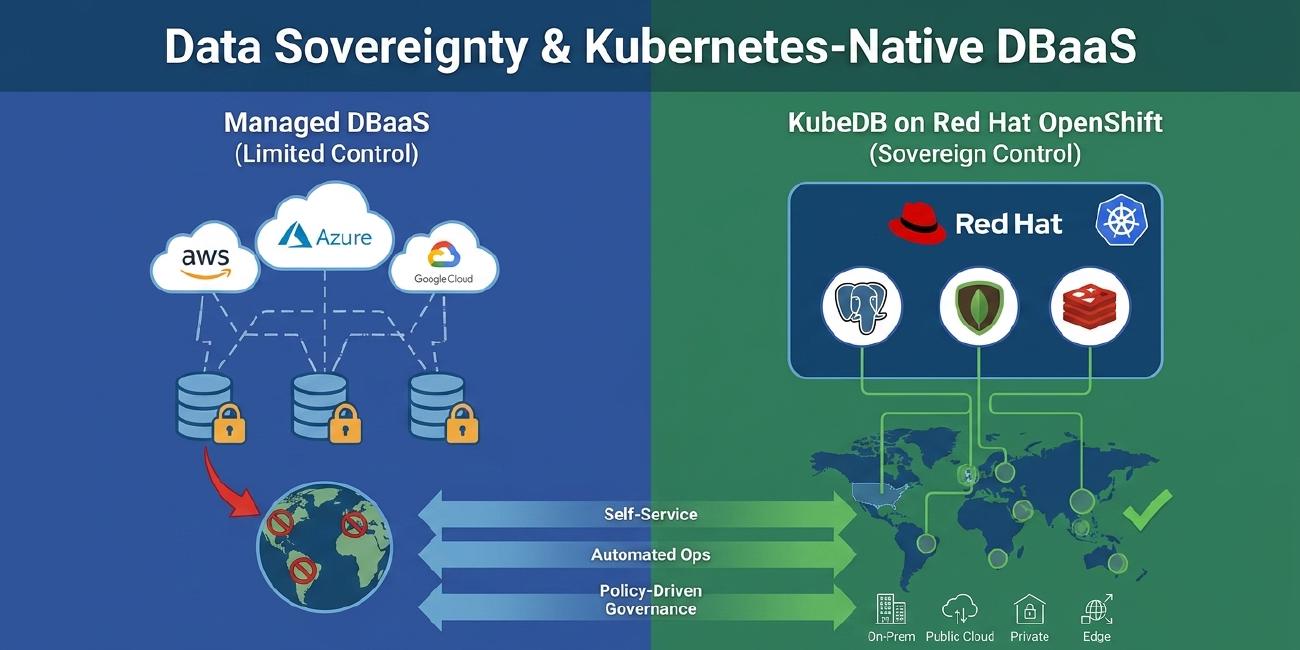
Managed DBaaS was built for the cloud era, when convenience and outsourced operations were the primary goals. But those trade-offs are becoming harder to accept for organizations operating across on-premises infrastructure, public cloud, edge locations, and regulated environments. Limited infrastructure control, regional constraints, provider lock-in, and the inability to support air-gapped deployments can make traditional managed services a poor fit for modern enterprise requirements.
For Red Hat OpenShift users, that gap is especially clear. OpenShift has become a standard platform for enterprise Kubernetes, giving platform teams a consistent foundation for deploying and managing applications. But when databases remain outside the platform in provider-managed services, teams are forced to work across separate tooling, fragmented automation workflows, and inconsistent security models. That creates friction where standardization should be delivering simplicity.
Kubernetes-native DBaaS changes that model.
Instead of treating the database as an external service controlled by a cloud provider, platforms like KubeDB bring database lifecycle management directly into the Kubernetes control plane. That shift matters because it restores control over deployment location, infrastructure choice, operational policy, and data locality. Databases can run wherever OpenShift runs—on-premises, in the public cloud, in private environments, or at the edge—without forcing teams into a provider-specific operating model.
Side-by-Side Comparison
| Capability | Managed DBaaS | KubeDB on Red Hat OpenShift |
|---|---|---|
| Deployment control | Provider-limited | Customer-controlled |
| Data residency and sovereignty | Region-bound | Policy-driven |
| Multi-cloud portability | Limited | Native |
| Kubernetes integration | External | Native |
| Air-gapped support | No | Yes |
This is where the difference becomes strategic. Traditional managed DBaaS optimizes for ease of consumption inside a provider’s environment. Kubernetes-native DBaaS gives platform teams a way to keep the operational benefits of DBaaS while retaining control over how and where databases run.
One reason managed DBaaS became attractive is that it removed much of the operational burden of running databases. That matters even more in on-premises and regulated environments, where backup policies, recovery workflows, access controls, and lifecycle management are often harder to standardize. KubeDB helps close that gap by giving platform teams a DBaaS-like operating model inside Red Hat OpenShift, with self-service provisioning, declarative database management, automated backups and recovery, and policy-driven governance.
Why Red Hat OpenShift Users Are Re-Evaluating DBaaS
Kubernetes Is the Platform—Why Keep Databases Outside?
If Red Hat OpenShift is the operational foundation, keeping databases outside the platform introduces unnecessary complexity. Teams end up juggling separate tooling, inconsistent security models, and disconnected automation. KubeDB closes that gap by making databases first-class Kubernetes resources, managed within the same operational framework as the applications they support.
Control and Flexibility Are Now Strategic Requirements
Organizations are moving beyond convenience. They need control over storage backends, network policies, data placement, and compliance requirements. With KubeDB, databases run wherever Red Hat OpenShift runs—on-premises, in public cloud, or at the edge, without requiring teams to re-architect applications around provider-specific services.
Data Sovereignty and Compliance Are Non-Negotiable
This is the core shift.
Managed DBaaS solutions often limit where and how data can be stored. For industries such as finance, healthcare, and government, that is more than an inconvenience, it can be a blocker. KubeDB supports a different model by enabling full control of data locality, support for sovereign and private environments, and deployment in air-gapped environments where cloud services cannot operate.
Multi-Cloud Should Be Real—Not Marketing
Many organizations describe themselves as multi-cloud, but their databases remain tightly tied to a single provider’s managed services. That limits flexibility when regulatory requirements, business priorities, or infrastructure strategy changes. KubeDB helps move stateful services toward a more portable model by using Kubernetes abstractions, supporting Red Hat OpenShift deployments across clouds, and enabling more consistent operations across environments.
A Consistent Operating Model Across Major Data Platforms
Just as importantly, KubeDB supports a broad range of widely used data platforms, including PostgreSQL, MySQL, MariaDB, MongoDB, Redis, Kafka, ClickHouse, Elasticsearch, OpenSearch, and Cassandra. That helps Red Hat OpenShift teams apply a more consistent operational model across diverse stateful workloads rather than solving each database problem in isolation.
Supported Databases
| Category | Engines |
|---|---|
| Relational | IBM DB2, MariaDB, Microsoft SQL Server, MySQL, Oracle, Percona XtraDB, PostgreSQL, SAP HanaDB |
| NoSQL / Document | Cassandra, DocumentDB, MongoDB |
| In-Memory / Cache | Hazelcast, Ignite, Memcached, Redis, Valkey |
| Search | Elasticsearch, OpenSearch, Solr |
| Analytics | ClickHouse, Druid, SingleStore |
| Messaging / Streaming | Kafka, RabbitMQ |
| Vector | Milvus, Qdrant, Weaviate |
| Graph | Neo4j |
| Coordination | ZooKeeper |
| Proxy / Pooler | PgBouncer, Pgpool, ProxySQL |
Platform Teams Still Want a True DBaaS Experience
Greater control does not have to come at the expense of usability. Platform teams still need to deliver a modern internal DBaaS experience to developers. KubeDB supports that model through self-service provisioning, declarative database management, automated backups and recovery, and policy-driven governance—all within the Kubernetes ecosystem. That means teams can improve control and compliance without giving up the automation and developer experience expected from a modern platform.
What the Red Hat Certification Means
KubeDB’s certification in the Red Hat Ecosystem Catalog reinforces the story for Red Hat OpenShift users. It validates compatibility with Red Hat OpenShift, supports enterprise confidence, and helps reduce adoption risk for organizations standardizing on Red Hat technologies.
The Bottom Line
Managed DBaaS solved a problem for the cloud era. But Kubernetes has changed the operating model, and data sovereignty is changing the buying criteria.
For Red Hat OpenShift users, the future of DBaaS is not simply about outsourcing database operations. It is about achieving automation without giving up control. That means a model that is sovereign, portable, and Kubernetes-native.
KubeDB is positioned for that shift by delivering DBaaS anywhere Red Hat OpenShift runs, with full control over data placement and operations, without sacrificing the automation platform teams expect.
Learn more about KubeDB | Try it today
We’d love to KubeDB for Red Hat OpenShift and see how a Kubernetes-native DBaaS model can simplify sovereign database operations across hybrid environments.
- Contact Us: Reach out via our website .
- Release Updates: Join our google group for release updates.
- Stay Updated: Follow us on Twitter/X for product announcements.
- Tutorials: Subscribe to our YouTube channel for tutorials on production-grade Kubernetes tools.
- Learn More: Explore Production-Grade Databases in Kubernetes .
- Report Issues: File bugs or feature requests on GitHub .