











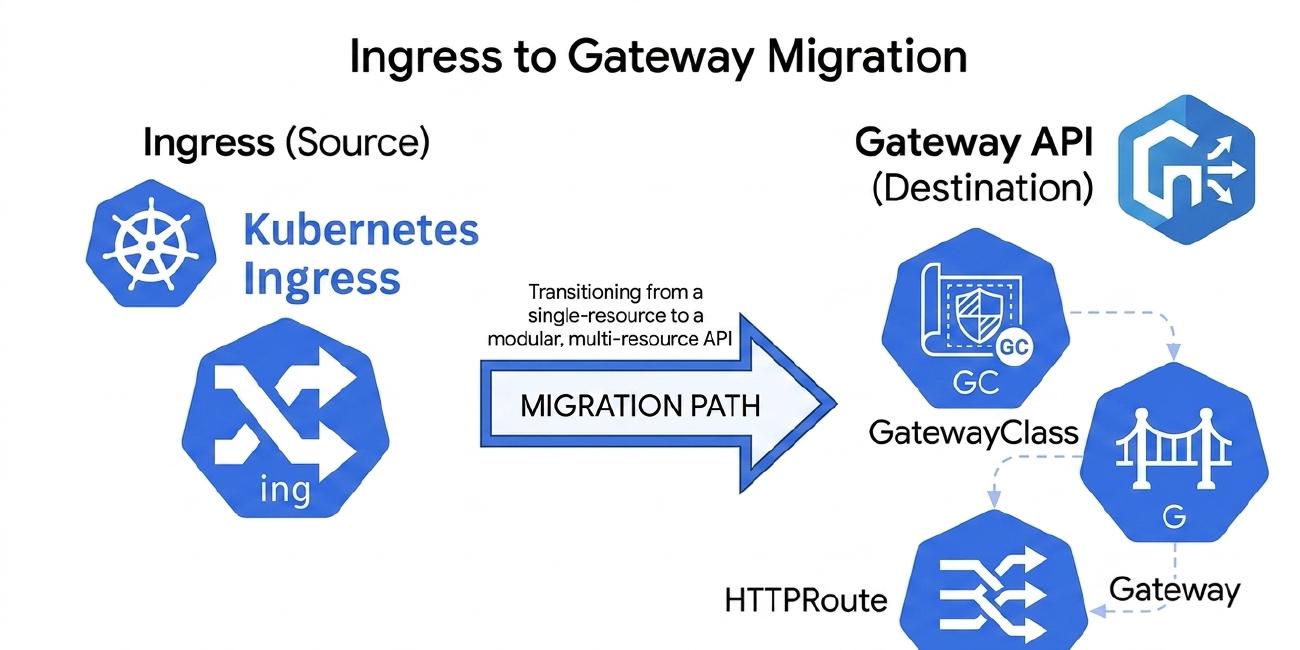
The Kubernetes Gateway API is the designated successor to Ingress. It offers richer routing semantics, native TCP/UDP support, explicit timeout configuration, upstream TLS policies, and a cleaner separation between infrastructure owners and application teams — all without relying on controller-specific annotations. For kubedb-platform, migrating to Gateway API was a clear improvement. The hard part was doing it without breaking anything for our existing self-hosted users.
This post explains the three-phase strategy we used to achieve a fully transparent, zero-downtime migration. In the full demonstration, Lets assume “dbaas.kubedb.cloud” is the domain user is using.
Phase 1: The Starting Point — Ingress Only
In the initial state, all HTTP(S) traffic is routed through nginx Ingress using the nginx-ace IngressClass. There are four Ingress objects in the ace namespace:
| Ingress | Purpose |
|---|---|
ace |
Main routing — 7 path-prefix rules across all ACE services |
ace-home |
Redirect / to /accounts/selfhost-home |
ace-nats |
Proxy WebSocket/HTTP traffic to NATS (regex path, upstream TLS) |
service-backend |
Route /bind/ to the service backend |
The main ace Ingress maps URL paths to backend services:
rules:
- http:
    paths:
    - path: /accounts   → ace-platform-api:80
    - path: /api        → ace-platform-api:80
    - path: /console    → ace-cluster-ui:80
    - path: /db         → ace-kubedb-ui:80
    - path: /id         → ace-platform-ui:80
    - path: /grafana    → ace-grafana:80
    - path: /prometheus → ace-trickster:4000
The ace-home Ingress uses nginx.ingress.kubernetes.io/rewrite-target: /accounts/selfhost-home to redirect root traffic. The ace-nats Ingress relies on two nginx-specific annotations — backend-protocol: HTTPS for upstream TLS and use-regex: "true" with a capture group in the path for stripping the /nats prefix before forwarding to the NATS service.
DNS is managed by an ExternalDNS resource named ace-ingress, which watches Ingress objects and registers:
dbaas.kubedb.cloud → <nginx LB IP>
This is the URL users know and use.
Phase 2: Dual-Stack — Gateway API Running Alongside Ingress
Before cutting over, we deploy the full Gateway API configuration alongside the existing Ingress objects. Both serve live traffic from their own load balancers during this phase.
The Gateway Resource
apiVersion: gateway.networking.k8s.io/v1
kind: Gateway
metadata:
  name: ace
  namespace: ace
spec:
  gatewayClassName: ace   # Envoy Gateway
  listeners:
  - name: http
    port: 80
    protocol: HTTP
  - name: https
    port: 443
    protocol: HTTPS
    tls:
      mode: Terminate
      certificateRefs:
      - name: ace-gw-cert
  - name: nats-tcp
    port: 4222
    protocol: TCP
  - name: s3proxy-tcp
    port: 4224
    protocol: TCP
The https listener terminates TLS using a certificate provisioned specifically for the Gateway. The two TCP listeners handle NATS and S3 proxy traffic at the transport layer — something Ingress simply cannot do.
HTTPRoutes Mirror the Ingress Rules
Each Ingress object has a corresponding HTTPRoute. The translation makes the implicit explicit.
Main routing (ace HTTPRoute):
rules:
- matches:
  - path: {type: PathPrefix, value: /api}
  backendRefs:
  - name: ace-platform-api
    port: 80
  timeouts:
    request: 2m
    backendRequest: 2m
# ... same pattern for /accounts, /console, /db, /id, /grafana, /prometheus
Explicit timeouts per route — not possible with standard Ingress.
Root redirect (ace-home HTTPRoute):
rules:
- matches:
  - path: {type: PathPrefix, value: /}
  filters:
  - type: URLRewrite
    urlRewrite:
      path:
        type: ReplaceFullPath
        replaceFullPath: /accounts/selfhost-home
  backendRefs:
  - name: ace-platform-api
    port: 80
The nginx.ingress.kubernetes.io/rewrite-target annotation is replaced by a standard URLRewrite filter.
HTTP→HTTPS redirect (ace-http-redirect HTTPRoute):
rules:
- matches:
  - path: {type: PathPrefix, value: /}
  filters:
  - type: RequestRedirect
    requestRedirect:
      scheme: https
      statusCode: 301
No annotation needed — this is a first-class Gateway API primitive.
NATS routing (ace-nats HTTPRoute):
rules:
- matches:
  - path: {type: PathPrefix, value: /nats}
  filters:
  - type: URLRewrite
    urlRewrite:
      path:
        type: ReplacePrefixMatch
        replacePrefixMatch: /
  backendRefs:
  - name: ace-nats
    port: 443
The regex path + capture group from Ingress is replaced by ReplacePrefixMatch. Upstream TLS validation (previously backend-protocol: HTTPS) is expressed as a separate BackendTLSPolicy resource that references the CA certificate and validates the upstream hostname — a proper policy object rather than an opaque annotation.
Two DNS Entries Coexist
A second ExternalDNS resource (ace-gw) watches the Envoy proxy Service (filtered by label) and registers:
ace.ace.dbaas.kubedb.cloud → <Envoy LB IP>
During Phase 2, both domains are active:
| Domain | Points To | Managed By |
|---|---|---|
dbaas.kubedb.cloud |
nginx LB | ace-ingress ExternalDNS |
ace.ace.dbaas.kubedb.cloud |
Envoy LB | ace-gw ExternalDNS |
Users can validate the new Gateway URL independently before any cutover.
Phase 3: The Switching Moment — Zero-Downtime Cutover
When the user is ready, they disable the ingress feature in their selfhost installer values and trigger an ACE upgrade or reconfigure:
# Before
ingress-dns:
  enabled: true

# After
ingress-dns:
  enabled: false
On the next upgrade, the ACE upgrader job automates the cutover in three steps.
Step 1: Helm Upgrade Deletes Ingress Resources
upgrader.UpdateACEInstaller() runs a helm upgrade with the new values. Since ingress-dns.enabled is now false, helm removes the ace-ingress ExternalDNS resource and all four Ingress objects from the cluster. The nginx LB still exists momentarily, but DNS no longer points to it.
Step 2: Upgrader Detects the Transition
The upgrader checks the installer values:
gatewayDNSEnabled := getNestedBool(installerValues, ..., "gateway-dns", "enabled")
ingressDNSEnabled := getNestedBool(installerValues, ..., "ingress-dns", "enabled")

if gatewayDNSEnabled && !ingressDNSEnabled {
    err = syncExternalDNS(kc)
}
Step 3: syncExternalDNS Performs the DNS Handoff
This is the critical piece. It cannot simply create the new DNS record immediately — the old ace-ingress ExternalDNS was just deleted by helm, but the deletion may not be complete yet. If both ExternalDNS resources try to own the same DNS record simultaneously, they will conflict.
The function waits for the deletion to complete before proceeding:
func waitForIngressExternalDNSToBeDeleted(kc client.Client) error {
    return wait.PollUntilContextTimeout(ctx, 3*time.Second, 20*time.Minute, true,
        func(ctx context.Context) (bool, error) {
            var ingDNS extdnsv1a1.ExternalDNS
            if err := kc.Get(ctx, ..., &ingDNS); errors.IsNotFound(err) {
                return true, nil   // gone, proceed
            }
            if ingDNS.Labels[meta_util.ManagedByLabelKey] == "Helm" {
                return false, nil  // still exists, keep waiting
            }
            return true, nil
        },
    )
}
Once deleted, copyExternalDNS creates a new ace-ingress ExternalDNS modeled on the existing ace-gw spec, but targeting the base domain instead of the ace.ace.* subdomain. It strips the ace.ace. prefix from the gateway’s DNS record to derive the base FQDN:
ace.ace.dbaas.kubedb.cloud → dbaas.kubedb.cloud
The new ExternalDNS watches the same Envoy proxy Service, so:
dbaas.kubedb.cloud → <Envoy LB IP>
The user’s existing URL now routes to Gateway — without any change on their end.
Cutover Sequence
Helm upgrade
  └─ delete Ingress objects (ace, ace-home, ace-nats, service-backend)
  └─ delete ace-ingress ExternalDNS

Upgrader polls: waiting for ace-ingress ExternalDNS to disappear...

  └─ create new ace-ingress ExternalDNS (source: Envoy Service)
       └─ DNS: dbaas.kubedb.cloud → Envoy LB IP  ✓

Users continue using dbaas.kubedb.cloud — now served by Gateway
Ingress vs Gateway API: What Changed
| Capability | Ingress | Gateway API |
|---|---|---|
| Path rewrite | nginx.ingress.kubernetes.io/rewrite-target annotation |
URLRewrite filter on HTTPRoute |
| Upstream TLS | nginx.ingress.kubernetes.io/backend-protocol: HTTPS annotation |
BackendTLSPolicy resource |
| HTTP→HTTPS redirect | Controller-specific annotation | RequestRedirect filter on HTTPRoute |
| Per-route timeouts | Not supported | Native timeouts field on HTTPRoute rule |
| TCP/UDP routing | Not supported | TCPRoute / UDPRoute + TCP/UDP listener |
| Regex path matching | ImplementationSpecific + use-regex annotation |
Not needed — ReplacePrefixMatch covers the common case |
Summary
The migration involved three stages: running ingress-only, running both in parallel, and then atomically handing off DNS at upgrade time. The dual-stack phase gave us a safe window to validate Gateway behavior before committing. The upgrader job’s syncExternalDNS function handled the DNS handoff automatically — waiting for the old record owner to be gone before claiming it, ensuring no conflict and no interruption for users.
Gateway API is now the default for all new ACE installations, and existing users migrate transparently on their next upgrade.